Thursday, May 5, 2011

Wednesday, May 4, 2011
Your Next Assignment: 19th Century Artists
19th Century Artists Blog Entry
To include:
- A 1-paragraph biography of the artist (in your own words!)
- A description of the art period he is from
- An explanation for how the artist fits that art period style
- Pictures of 2 of his most famous works that illustrate what you just explained
- A paragraph for each picture explaining why that art piece is significant (what does it show about the artist/time period/art style/etc.)
- Hyperlinks to your sources
*** Type it in Word first and save it, just in case!***
Monday, April 18, 2011
Elizabeth I
Queen Elizabeth I was a wise and great leader who had lived a long life and still found courage enough to be one of the first women to hold on to her position of power.
Birth: 1533 in London
Death: 1603

Life: Mother was beheaded at the Tower of London in 1536. In 1547 King Henry VIII died and Elizabeth’s half-brother became King Edward VI, he died in 1553 and Elizabeth’s half-sister became Queen Mary I. Elizabeth was imprisoned in the Tower of London and then Woodstock Manor in 1554 and was freed in 1555. Queen Mary I died in 1558 and Elizabeth became Queen. In 1562 Elizabeth became seriously ill with small pox. Queen Elizabeth I was excommunicated by the Pope in 1570. In 1571 an assassination plot on Queen Elizabeth I became known. The war with Spain began when Elizabeth took the Netherlands under her protection. The Spanish armada was defeated first in 1588 and again in 1597. In 1601 Elizabeth performed what would become known as her Golden Speech.
Accomplishments:
-She brought the Church of England back.
-She helped Protestants in the Netherlands by sending an army.
-Elizabeth dubbed herself the Virgin Queen

http://www.elizabethi.org/us/
http://tudorhistory.org/elizabeth/
http://www.greatkat.com/03/elizabeth.html
Sam E.
Birth: 1533 in London
Death: 1603

Life: Mother was beheaded at the Tower of London in 1536. In 1547 King Henry VIII died and Elizabeth’s half-brother became King Edward VI, he died in 1553 and Elizabeth’s half-sister became Queen Mary I. Elizabeth was imprisoned in the Tower of London and then Woodstock Manor in 1554 and was freed in 1555. Queen Mary I died in 1558 and Elizabeth became Queen. In 1562 Elizabeth became seriously ill with small pox. Queen Elizabeth I was excommunicated by the Pope in 1570. In 1571 an assassination plot on Queen Elizabeth I became known. The war with Spain began when Elizabeth took the Netherlands under her protection. The Spanish armada was defeated first in 1588 and again in 1597. In 1601 Elizabeth performed what would become known as her Golden Speech.
Accomplishments:
-She brought the Church of England back.
-She helped Protestants in the Netherlands by sending an army.
-Elizabeth dubbed herself the Virgin Queen

http://www.elizabethi.org/us/
http://tudorhistory.org/elizabeth/
http://www.greatkat.com/03/elizabeth.html
Sam E.
Friday, April 15, 2011
Galileo
Galileo was a scientist.

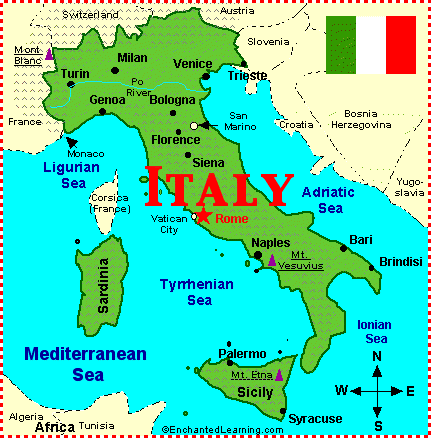
He was born in Italy in 1564

Built the first telescope.

He thought the planets went around the sun, but everyone else thought the planets went around the earth caused a lot of problems no one believed him.

With his thought of the planets he had to go to trial and he was grounded he could not leave his house or also known as house arrest.
Galileo died in 1642 at his house in Italy still on house arrest.
- Dominic W.

He was born in Italy in 1564
Built the first telescope.

He thought the planets went around the sun, but everyone else thought the planets went around the earth caused a lot of problems no one believed him.

With his thought of the planets he had to go to trial and he was grounded he could not leave his house or also known as house arrest.
Galileo died in 1642 at his house in Italy still on house arrest.
- Dominic W.
Suleiman the Magnificent
Jacob Brumaghin

 Suleiman I “the Magnificent” (name given by the Europeans) was born April 27, 1495 in Trebizond Turkey, died September 5, 1566 in Szigetvar Hungary at the age of 72 while conducting the siege of Szigetvar in Hungary. He is buried in Süleymaniye Mosque Istanbul. He was a straight(sexual orientation) Muslim from the middle east. In 1520 at the age of 25 he became royalty “sultan” or monarch of the Ottoman Empire a “lawgiver” in Islam, he preceded his father Selim I and became the tenth and longest reigning sultan in the Ottoman empire for 47 years. He was not only born during the most glorious period in Islamic history he was born while the renaissance was happening in Europe. His father handed down a well organized country with many willing warriors and allot of money. Suleiman partnered up with Francis I the king of France, they fought against Charles V who was the holy roman emperor at the time, he also brought in a new improved system for feudal tenures (specified jobs) as well as improving the military thus creating the biggest Ottoman fleet ever. Dominating the Red Sea, Mediterranean sea, and Persian Gulf, these strong armies conquered the Christian strongholds of Belgrade, Rhodes, and Hungary. He annexed (took) most of the middle east and large chunks of north America (all the way to Algeria) he took this land from the safavids(Iranian dynasty). Suleiman improved not only the army but the economy, education, and criminal law, taxes started to be collected, so basically Suleiman ruled the golden age of the Ottoman empire creating artistic, literary, and architectural development. Suleiman spoke six different languages, Ottoman Turkish, Arabic, Bosnian, Chagatai(dialect of Turkish language), and Persian. Suleiman was a sultan by day and a poet (under the pseudonym (pen name) of Muhibbr) and goldsmith by night; he broke tradition and married a harem girl named Aleksandra Lisowska also known as Roxelana bringing a raise in harem influence (polygamy), Suleiman had four sons and one daughter his four sons names were Mustafa, Selim II, Bayezid, Cihangir and his daughter was Mihrumâh - Mihrimar. He is so important because he was not only a poligamist but he was the biggest influence on islamic world in the ways he ruled with his laws and ideas.

proof of importance
 Suleiman I “the Magnificent” (name given by the Europeans) was born April 27, 1495 in Trebizond Turkey, died September 5, 1566 in Szigetvar Hungary at the age of 72 while conducting the siege of Szigetvar in Hungary. He is buried in Süleymaniye Mosque Istanbul. He was a straight(sexual orientation) Muslim from the middle east. In 1520 at the age of 25 he became royalty “sultan” or monarch of the Ottoman Empire a “lawgiver” in Islam, he preceded his father Selim I and became the tenth and longest reigning sultan in the Ottoman empire for 47 years. He was not only born during the most glorious period in Islamic history he was born while the renaissance was happening in Europe. His father handed down a well organized country with many willing warriors and allot of money. Suleiman partnered up with Francis I the king of France, they fought against Charles V who was the holy roman emperor at the time, he also brought in a new improved system for feudal tenures (specified jobs) as well as improving the military thus creating the biggest Ottoman fleet ever. Dominating the Red Sea, Mediterranean sea, and Persian Gulf, these strong armies conquered the Christian strongholds of Belgrade, Rhodes, and Hungary. He annexed (took) most of the middle east and large chunks of north America (all the way to Algeria) he took this land from the safavids(Iranian dynasty). Suleiman improved not only the army but the economy, education, and criminal law, taxes started to be collected, so basically Suleiman ruled the golden age of the Ottoman empire creating artistic, literary, and architectural development. Suleiman spoke six different languages, Ottoman Turkish, Arabic, Bosnian, Chagatai(dialect of Turkish language), and Persian. Suleiman was a sultan by day and a poet (under the pseudonym (pen name) of Muhibbr) and goldsmith by night; he broke tradition and married a harem girl named Aleksandra Lisowska also known as Roxelana bringing a raise in harem influence (polygamy), Suleiman had four sons and one daughter his four sons names were Mustafa, Selim II, Bayezid, Cihangir and his daughter was Mihrumâh - Mihrimar. He is so important because he was not only a poligamist but he was the biggest influence on islamic world in the ways he ruled with his laws and ideas.
proof of importance
The Medici's (Lorenzo)
 Summary—Lorenzo de’ Medici was a wealthy bank owner and partial ruler of Florence who came from a ruling family called The Medici’s.
 Born—January 1, 1449 Florence, Republic of Florence
Death—April 9, 1492 Careggi, Republic of Florence
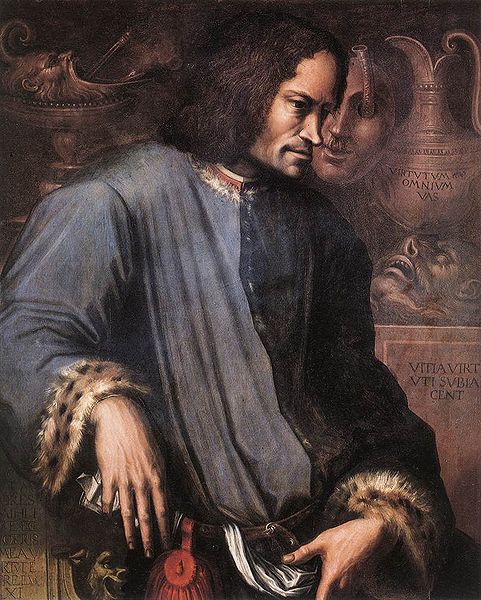 Life— Parents are Piero ‘the Gouty’ de’ Medici and Lucrezia Tornabuoni. Father was an art patron and collector. Mother was a poet and writer of sonnets. When his father died he got the leading role in running the Medici Bank. When he started running the bank the assets declined seriously. Like the rest of his family he ruled Florence indirectly. In 1478 a group of people tried to assassinate him, but he survived while his younger brother Giuliano died. He is said to be the most brilliant of all the Medici’s. His death came the same time that The Battle of Centaurs ended.
 Accomplishments—His lasting power on art can still be felt today. Influenced what some artists painted or drew. He didn’t just make the art about the church. He brought new artists and art styles into the modern art that we know today.
 Impact—Mostly he funded artists that most other people would not have to he let them have a say in an art world that didn’t normally accept them.
Go to his life bio: http://en.wikipedia.org/wiki/Lorenzo_de'_Medici
Go to an art info bio: http://www.nga.gov/collection/gallery/itasculp/itasculp-12189.html
Go to a partial bio: http://www.britannica.com/EBchecked/topic/372332/Lorenzo-de-Medici
Go to a full bio: http://hubpages.com/hub/Lorenzo-de-Medici
~Ashley Sharp~
Nicolaus Copernicus
 Copernicus was a famous renaissance mathematician and astronomer and the first person to formulate a comprehensive heliocentric cosmology.
 Nicolaus Copernicus was born in Torun, Poland on February 19, 1473. He was the youngest of four children. In 1466, Russia turned west Russia which included Torun over to the Polish who declared it a free city of the Polish Kingdom. His father died in 1483 and his uncle, Lucas Watzenrode took them under his protection. His uncle was to become bishop of Warmia in 1489. He enrolled in the University of Cracow in 1491. There is no evidence of him earning a degree. His heliocentric idea of the university was thought to go against the Bible so he earned lots of criticism for his ideas. He died on May 24, 1543 on the same day that he was presented with a copy of his published book.

He has changed the world by altering our view on how the solar system is comprised and started modern astronomy.
For more in-depth information, go to:
http://plato.stanford.edu/entries/copernicus/
For more general information, go to: http://en.wikipedia.org/wiki/Nicolaus_Copernicus
To read more about his book, go to:
Cody H.
Subscribe to:
Posts (Atom)