Friday, May 6, 2011

Pierre-Auguste Renoir By: Jacob Brumaghin

Pierre-Auguste Renoir was an artist that was born in Hautte-Vienne, France on February 25, 1841 . He resided in Paris, France and studied with Charles Gleyre, Alfred Sisley, Frédéric Bazille, and Claude Monet. He painted nudes and other scenes as well as made fine china he died December 3, 1919.


Impressionism- An art movement in the 19th century that came about because of French artists who became famous through independent exhibitions. Impressionism has very small lines, thin lines, that are still visible. Depicts light in changing quantities, includes movement.

Dance at Le Moulin de la Galette- This is very important due to his small tiny strokes as well as the scene.
Le Moulin de la Galette by Pierre-Auguste RenoirLuncheon of the Boating Party, 1880–1881- This is also important because of the small strokes and beautieful scene and colors/contrast

Jean-Francois Millet

Jean- Francois Millet was born on October 4, 1814. Millet was born into a peasant family. He spent most of his childhood working on the land. By the age of nineteen he was studying art in Cherbourg. In 1837 he arrived in Paris and eventually enrolled in the studio of Paul Delaroche. Millet got rejected for one of his entries for the Salon of 1840 so he decided to return to Cherbourg. He remained in Cherbourg for most of 1841 painting portraits. He achieved his first success on a painting called “The Milkmaid” and another painting called “The Riding Lesson”. Millet started doing paintings of peasants. In 1849, after a period of great hardship, Millet left Paris to settle in Barbizon, a small cabin in the forest of Fontainebleau. He continued to paint portraits of peasants. In 1868 Millet’s work was wanted by many people after nine major paintings were shown at an exhibit. His art work can be found in the Museum of Fine Arts, Boston, and in the Louvre. Jean died in January 20, 1875.


Realist: a realist depicts objects and people as they actually appear in real life.

 
These pictures are important because it shows how Jean- Francois Millet was a realist painter. His art work resembles what people really look like and shows people doing everyday work. That is how realist artists paint.

Click here for images
Click here for other images


Jordan


Van gogh

VINCENT VAN GOGH

born-
March 30, 1853

died-
July 29, 1890


Vincent Van Gogh was a dutch post impressionist painter whose work had a far-reaching influence on 20th century art for its vivid colors and emotional impact. He suffered from anxiety and increasingly frequent bouts of mental illnes throughout his life and died, largely unknown, at the age of 37 from a self-inflicted gunshot wound.the post impressionist age extended imperessionism while rejecting its limitations. they continued using vivid colours, thick application of paint, distinctive brush strokes, and real-life subject matter, but they were more inclined to emphasize geometric forms, to distort form for expressive effect, and to use unnatural or arbitrary colour.


Starry Night is being considered a hight of the geniality of the author. Vincent Van Gogh was fascinated by the sky and the night. He painted Starry Night in a few days, probably from his memory or from the word of the Saint-Remy Hospital, we don't think he could have being out on his own.
In the Starry Night, experts believe that Vincent was representing the Via Lactea, a scientific discovery very recent in that time. 

MARK MURRAY!!

Edgar Degas

Nik Esposito
Humanities-2
5/6/11

Edgar Degas

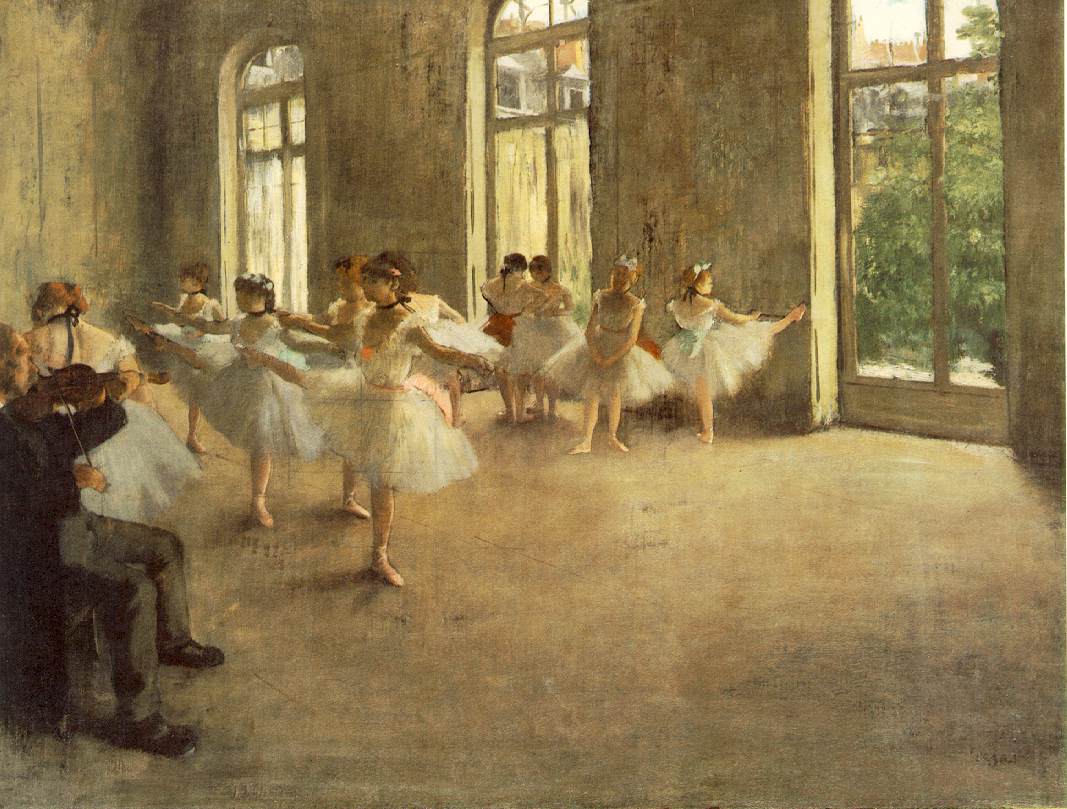
He was born 19 July 1834 and died September 27, 1917. He was a French artist famous for his work in painting, sculpture, printmaking and drawing. He was one of the first impressionist painters, and was said to be a founder of it although he preferred to call it realism. He is especially identified with the subject of the dance, and over half his works depict dancers. He wanted to be a history painter, a calling for which he was well prepared by his rigorous academic training and close study of classic art. In his early thirties, he changed course, and by bringing the traditional methods of a history painter to bear on contemporary subject matter, he became a classical painter of modern life.

Impressionism: Degas is often identified as an Impressionist, an understandable but insufficient description. Impressionism originated in the 1860s and 1870s and grew, in part, from the realism of such painters as Courbet and Corot. The Impressionists painted the realities of the world around them using bright, dazzling colors, concentrating primarily on the effects of light, and hoping to infuse their scenes with immediacy.

Edouard Manet

Edouard was a french painter in the 19th century. He was born 1832 and died 1883. he was one of the first artist to apporch modern life. He was born in-to the upper class society. In 1856, Manet opened his own studio. His style in this period was characterized by loose brush strokes, simplification of details and the suppression of transitional tones. The roughly painted style and photographic lighting in these works was seen as specifically modern, and as a challenge to the Renaissance works Manet copied or used as source material. His work is considered 'early modern'.
He completed painting his last major work,A BAr at the Folies Begrere, in 1882 and it hung in the Salon that year.
In 1875, a book-length French edition of Edgar Allan Poe "The Raven " included lithographs by Manet and translation by Mallarmé.
In 1881, with pressure from his friend Antonin Proust , the French government awarded Manet the Legion. d'Honneur
Bridget A

Louis Tiffany

During his life, Louis Comfort Tiffany (1848 – 1933) was a painter, interior designer, collector, world traveler, photographer, manufacturer and avid gardener. Today he is commonly recognized as one of America’s most influential artists, designers and craftsmen of his century. Tiffany clearly influenced local Napier architect, Louis Hay , resulting in the famous grape and fruit motifs used in many of the leadlight in The Master's Lodge.


Louis Comfort Tiffany was the son of Charles Lewis Tiffany, founder of Tiffany & Co., America’s foremost retailer of luxury goods. Although his father had initially hoped that his son would succeed him as head of the company, Louis Comfort Tiffany's early interest was in painting. In the 1860s and 1870s, Louis studied under the American landscape painter George Inness, Tiffany combined the use of light, colors and nature in his work. He received praise for his oils and watercolors, which included scenes from his travels in Europe and North Africa. By 1879, Tiffany had established himself as a serious artist.

In the same year, he also seized up the suggestion of Candace Wheeler that he join with Samuel Colman and Lockwood de Forest to form a firm that would apply aesthetic idealism to the practice of interior design. Impelled by Tiffany's leadership and nascent talent, as well as by his father's money and connections, Louis Comfort Tiffany and Associated American Artists thrived in the fields of interior design and decorative arts. His commissions for Mark Twain, Cornelius Vanderbilt and the White House under President Arthur earned him an international reputation and great success. Stained-glass windows were a feature in these interiors.

Tiffany actually had begun his glass experiments about 1875 to 1878, when he was working at glasshouses in Brooklyn, where his later rival, John La Farge was also working, both being particularly interested in colored and opalescent glass. In 1880-81, Tiffany began designing glasswork of remarkable beauty. His unique style became a driving force behind the emergent Art Nouveau style, challenging the current Victorian ornate style. Art Nouveau used free-flowing designs based on nature that exemplified the characteristics prevalent in Tiffany’s earlier creations as a landscape painter. The use of light, colors and nature assumed greater significance in Tiffany’s work as he developed his unique approach. Tiffany wanted to elevate decorative arts to the level of fine arts, available to a wide audience.


He incorporated Tiffany Glass Company on December 1, 1885, which later became known as Tiffany Studios. In 1895, his glassware was exhibited in Samuel Bing's Gallery "L'Art Nouveau" in Paris. In 1902, he became art director of his father's legendary company, Tiffany & Co. in New York. He designed for the firm coloured glass table lamps and lampshades, which were made in more than one edition. It was Thomas Edison who urged him to focus on electric light production after their collaboration on the design of the first Moving Picture Theater. Tiffany also designed and produced glass vases, tiles, mosaics and stained-glass-windows.

The pieces he produced between the 1890s and 1918 were magnificent, exotic and of the highest quality. He mass-produced work of superior design with outstanding handcrafted details and he patented various types of glass, amongst them the iridescent glass called "Favrile". Tiffany functioned as the ultimate authority over more than three hundred workers, designers and artists, glass blowers and gaffers, and artisans of numerous other tasks.

By Tiffany’s death in 1933, the popularity of his decorative works declined with the rise of Art Modern and Expressionism. For two decades the designs of Louis Comfort Tiffany were forgotten. It was not until the first Tiffany retrospective show in 1958 that museums and collectors rediscovered his objects. Awareness of Tiffany’s craftsmanship escalated with an Art Nouveau show in 1960 at the Museum of Modern Art. Today the designs of Louis Comfort Tiffany are honored and treasured around the world, confirming Tiffany’s legacy as a visionary of Art Nouveau design.


Kayla Danzeisen


Thursday, May 5, 2011

Paul Cezanne


                                          Paul Cezanne
Paul Cezanne was a post- impressionist artist in the late 1800’s to the early 1900’s. Paul Cezanne was born January 19th, 1839, in the small town of Cesana. Between 800 and 900 of Cezanne’s paintings are known today. Paul Cezanne’s paintings inspired Picasso, the geometric designs and the primary colors: red, yellow, and blue. Paul Cezanne died of pneumonia in 1907.
Jaccob W.